
Why concrete scales
When saturated concrete freezes, the water in it expands and stresses the surface. Deicers make it worse by keeping the surface wetter and adding freeze-thaw cycles. Air-entrained concrete contains millions of tiny bubbles that give the ice room to expand, which is why industry guidance calls for about 6 percent air in exterior slabs (NRMCA CIP 2). The same guidance lists the usual causes of scaling: too little entrained air, weak or wrongly proportioned concrete, excessive deicer on new concrete, improper finishing and insufficient curing.
The first winter
New concrete is saturated and still gaining strength. Keep deicers off it through the first winter, shovel promptly, and use clean sand for traction. After that, use deicers in moderate amounts; heavier applications raise the risk of scaling.
Which deicers
| Product | Guidance for concrete |
|---|---|
| Sodium chloride (rock salt) | Acceptable in moderate amounts |
| Calcium chloride | Acceptable in moderate amounts |
| Ammonium nitrate or ammonium sulfate | Never; chemically aggressive to concrete |
| Magnesium-based salts | Never; also tracked in from pre-treated roads |
Source: NRMCA CIP 2. Check the label of any blend before you buy it.
Salt from the road
Cars carry road salt into driveways and garages. Hosing off accumulated salt when temperatures allow, and making sure meltwater drains off rather than pooling, both reduce exposure; poor drainage that lets salt solution sit on the slab makes scaling more severe. Pile snow where the melt will run away from the slab, not across it.
Sealing the surface
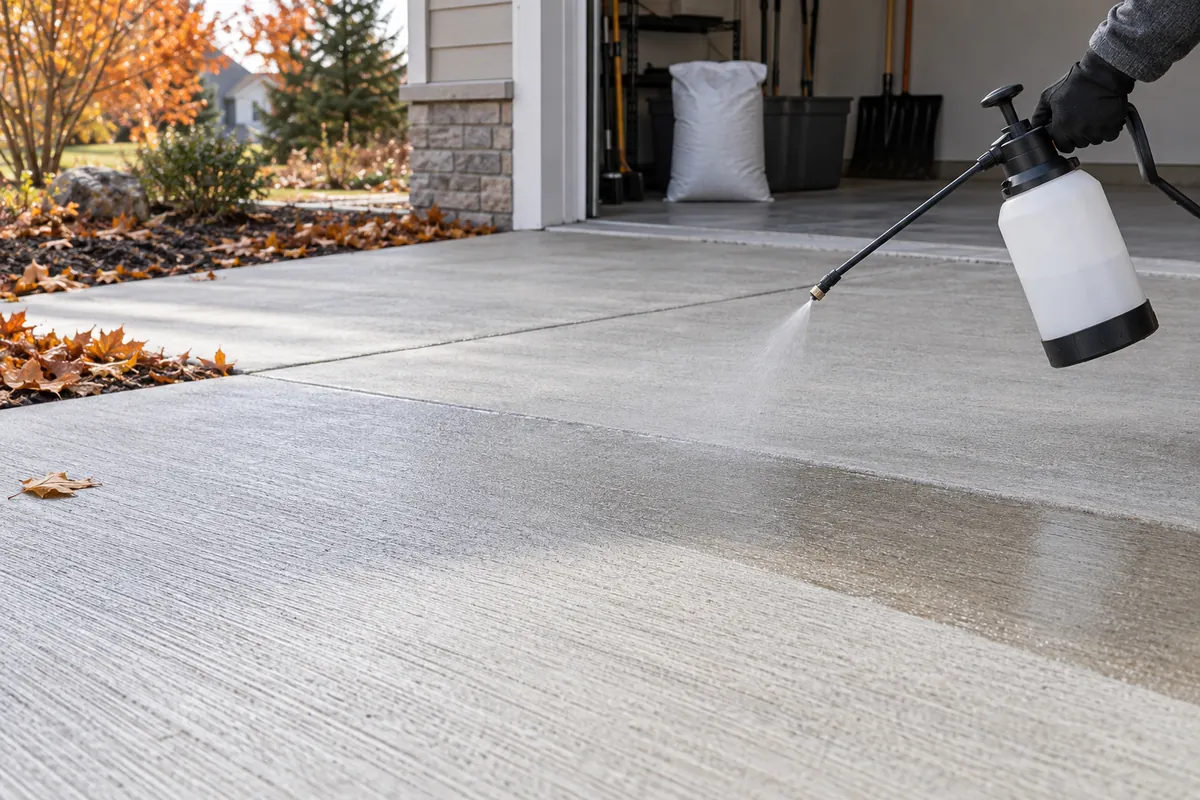
A commercial breathable sealer or water repellent based on silane or siloxane, made for concrete slabs, adds protection. Apply it to clean, reasonably dry concrete and follow the manufacturer's instructions; late summer after a few dry days is ideal. A sealer does not fix a slab that holds water, a moving crack or poor-quality concrete. Stamped concrete has its own sealer schedule.
After the thaw
Walk the driveway and walks in spring and photograph any flaking, pitting or new cracks. Minor scaling is cosmetic; spreading scaling is a repair conversation.