
Spring: wait for the ground
Frost leaves the ground unevenly, and a thawed surface can sit over soil that is still frozen or saturated. Snow and ice must be removed and every surface the concrete touches should be above freezing before placement, according to NRMCA's cold-weather guidance. Spring is also when heave and settlement from the winter show, so photograph them before they settle back.
Summer: easy season, different risk
Warm weather speeds up setting and strength gain, and the risk shifts to drying. The surface must not dry out before it sets, and curing should continue, typically for 3 to 7 days, using a curing compound, wet coverings or plastic sheeting (NRMCA CIP 11). Ask which method your technician uses.
Fall: the protection window
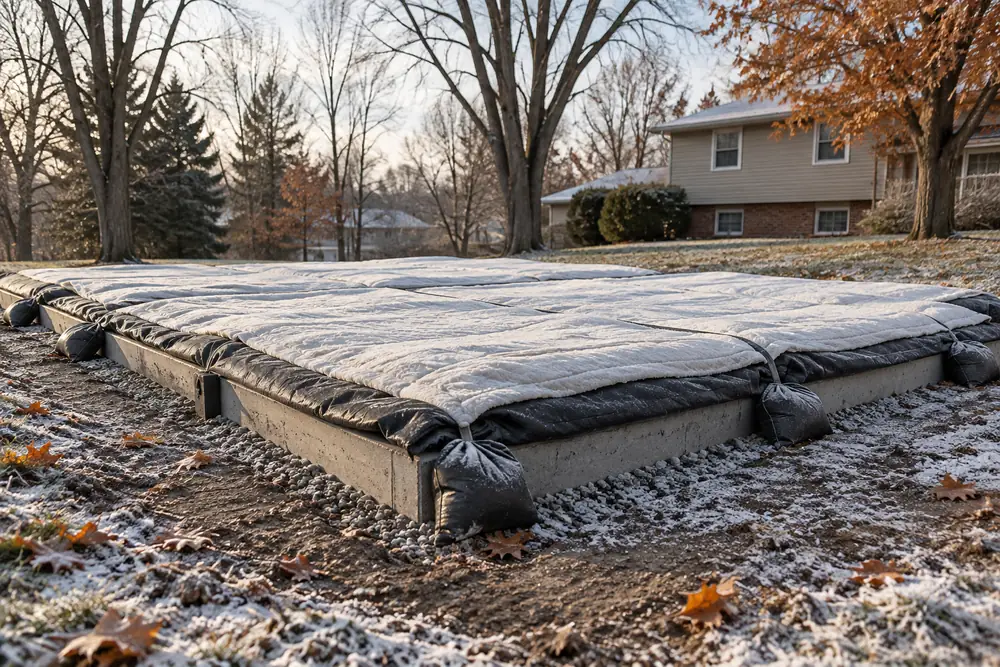
Cold slows everything: a 20°F drop in concrete temperature roughly doubles the setting time, so a late pour takes longer to finish and to gain strength. Fresh concrete freezes at about 25°F, and freezing early can cut its potential strength by more than half. It needs protection until it reaches 500 psi and protection from repeated freeze-thaw until 3,500 psi. Insulated blankets, straw under plastic, enclosures and vented heaters are the usual tools. NRMCA also cautions against placing exterior concrete late in the season if it will freeze while still saturated (CIP 2).
| Question for a fall pour | Why it matters |
|---|---|
| Is the mix air-entrained? | Air bubbles protect the slab from freeze-thaw. |
| What protection is on site? | Blankets or heat have to stay on until the slab is strong enough to survive a freeze. |
| How warm will the concrete be as placed? | NRMCA lists 55°F for sections under 12 inches thick. |
| When can it take deicer? | Not in its first winter. |
Winter: plan and quote
Deep winter is for measuring, photographing damage, checking the town permit rules and lining up quotes. Concrete can be placed with heated enclosures, but ordinary flatwork is far easier to schedule once the ground thaws.
Before the first shovel
Any excavation needs a utility locate: in Minnesota, notice to Gopher State One Call at least 48 hours ahead, not counting the day of notice, weekends and holidays (Minn. Stat. 216D.04); in Wisconsin, 3 working days' notice to Diggers Hotline (Wis. Stat. 182.0175). The winter-care guide covers the slab's first winter.